IN ILLO TEMPORE
I dreamed a courtyard of rose-red stone, hung with flowers, filled with sun. And as we stepped into the ancient house, I took you by the hand, and you delighted in the place: here is where we live, you said.
Birds stumbled through the liquid leaves, scattering their song across the sky, and all through the summer dim, we wandered the courtyards of Scotland, until the sky paled to opal and summer filled the morning up.
More than a returning, this, more than reconciliation. Across this border now, in my once-remembered country, the ancient stones turn red and warm, glow like honey in the perfumed night - and I know you again, find you at last, in an endless turning to the light.
Outside the courtyard, beyond the stones, beyond the mornings and the hooded nights, outside of then or now or soon, or here or there or other where, I will always take your hand, beneath the roses and the singing sun.
Ningbo, China, 23-24 May 1989
Dreams of wholeness, of integration, of union: what is it that fills the spaces between the stars, or binds the quantum strangeness of particles? Is love the dark matter that holds the universe together?
I woke that first morning in Ningbo, knowing that I had been given a great gift, and the poem I began was only a reflection of something larger: the next day's dream completed the story, but I'm still unable to say it any other way. I didn't see it then as a love poem, though it can be so read. For twenty years I had lived in Scotland and my waking hours had been largely spent reading Chinese and reading about China, but China never came into my dreams. When at last I arrived in Hangzhou, I dreamed - as you'd expect - about Scotland, but this was the first sign the two could be integrated.
Why am I dreaming about that time in my life?
Sunday, November 25, 2007

and all dark things before it are made bright
i the green gless a saumon soums
bull i the stane
i the wan gless a seamaa hings
the bull's i the stane
i the gowden gless an eagle's risin
the bull's i the stane
the stane's a derk gless
i the derk gless
seamaa, saumon
stauns the bull
fauld yir wings about uis
sterk an strang
seamaa, saumon i the stane
strang i the mirk
fauld yir wings about uis
doun i the derk gless
seamaa, saumon i the stane
the sterk bull stauns
Engines of contemplation, dark mirrors where understanding swims unseen, empty vessels where dreamers read their future and divine their past?
Can it be true that the stones watch over us, raising bright wings radiant with meaning, to keep us from harm?
Only at this moment, here at every second, love is made manifest. All that is true for us stands true for ever: subtle the paradox inhabited by lovers, and endless the ocean in which they swim.
No visitor from the stars but is the same as they are
(Hugh MacDiarmid On a Raised Beach)
and all dark things before it are made bright
(Swinburne)
bull i the stane
i the wan gless a seamaa hings
the bull's i the stane
i the gowden gless an eagle's risin
the bull's i the stane
the stane's a derk gless
i the derk gless
seamaa, saumon
stauns the bull
fauld yir wings about uis
sterk an strang
seamaa, saumon i the stane
strang i the mirk
fauld yir wings about uis
doun i the derk gless
seamaa, saumon i the stane
the sterk bull stauns
Engines of contemplation, dark mirrors where understanding swims unseen, empty vessels where dreamers read their future and divine their past?
Can it be true that the stones watch over us, raising bright wings radiant with meaning, to keep us from harm?
Only at this moment, here at every second, love is made manifest. All that is true for us stands true for ever: subtle the paradox inhabited by lovers, and endless the ocean in which they swim.
No visitor from the stars but is the same as they are
(Hugh MacDiarmid On a Raised Beach)
and all dark things before it are made bright
(Swinburne)
Saturday, November 24, 2007
saumon i the stane?
Whit's that aa about?
(Salmon in the stone, for non-Scots-speakers)
(Salmon in the stone, for non-Scots-speakers)
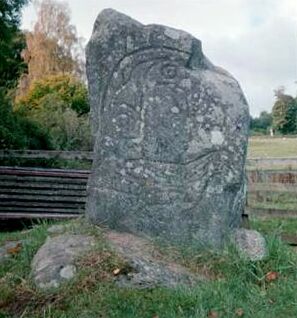
The ancient symbol stones of Scotland display images of animals that can still excite us to awe or wonder, though we know nothing of what they meant to their creators. Salmon, eagle, bull, horse and deer - they can draw us toward a reverence for the natural powers that surround us - air and water, earth and fire - and inspire us towards wisdom.
We call them Pictish for lack of any other name, but since recent DNA evidence suggests that most of us in Scotland have always been there, and that we are in fact mostly descended from speakers of the lost languages of the British Isles, I'm comfortable, as a half-Irish Border Scot with Scandinavian tinges, to call them my own, and to call out to them in my dreams.
its
our dreamin
time
hairts
muves
muves
our dreamin hairts
time
be na feart, be na feart
And in our dreams, these emblematic figures move us toward becoming who we are. Each step we take towards becoming who we are, each insight or vision, slowly helps us to inhabit the world better. We also inhabit the word, and that is the poem's function: the marriage of words and worlds.
So what can the salmon in the stone tell us?
Subscribe to:
Posts (Atom)